Broken or Cracked Tooth: Can It Be Saved or Does It Need to Be Extracted?
A broken or cracked tooth can happen suddenly. Maybe you bit down on something hard, an old filling gave way, or a tooth that had been bothering you finally broke. Sometimes there is immediate pain. Other times, you may notice only a sharp edge or a piece of tooth missing.
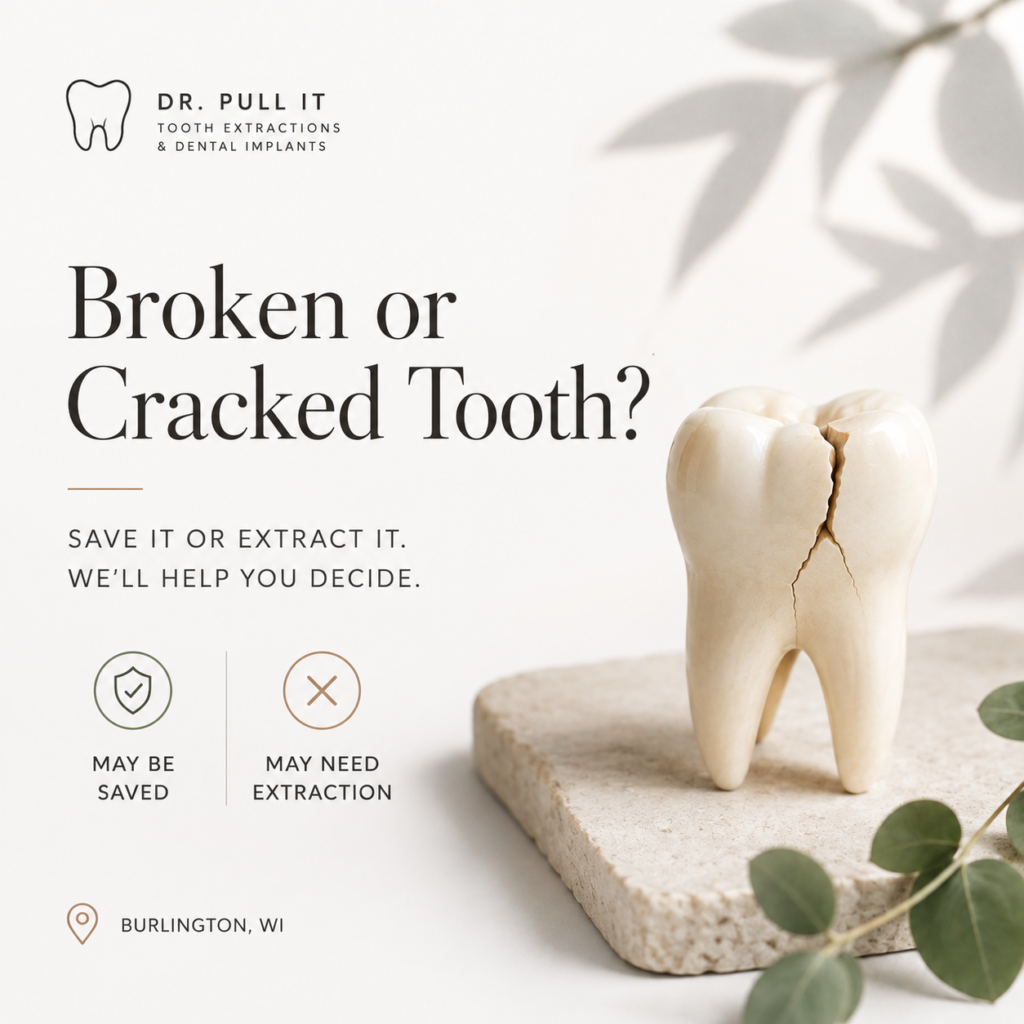
The big question is usually the same: Can the tooth be saved, or does it need to be extracted?
The answer depends on how much of the tooth is damaged, where the crack extends, whether the nerve is involved, and whether there is an infection. Some broken teeth can be repaired, while others may be too damaged to predictably restore.
What Causes a Tooth to Break or Crack?
Teeth are strong, but they can still fracture. Common causes include:
-
- Biting down on hard foods or objects
-
- Large or older fillings that weaken the remaining tooth
-
- Untreated tooth decay
-
- Grinding or clenching your teeth
-
- Trauma or injury
-
- Cracks that gradually worsen over time
-
- Teeth that have become structurally weakened
Sometimes a tooth breaks without much warning, especially when decay has weakened it from the inside.
What Are the Signs of a Cracked or Broken Tooth?
A damaged tooth does not always cause constant pain. You may notice:
-
- A visible crack or missing piece of tooth
-
- A sharp or rough edge
-
- Pain when biting or chewing
-
- Sensitivity to hot or cold
-
- Pain that comes and goes
-
- Swelling around the tooth or gums
-
- A bad taste or drainage near the tooth
-
- Increasing pressure or throbbing pain
If you develop significant facial swelling, difficulty swallowing or breathing, fever, or rapidly worsening symptoms, seek urgent medical or dental attention.
Can a Broken or Cracked Tooth Be Saved?
Sometimes, yes.
The treatment depends on the location and severity of the damage. A dentist may be able to save a tooth with treatments such as a filling, crown, or root canal followed by an appropriate restoration.
For example, a relatively small fracture that does not extend deeply into the tooth may still have enough healthy structure to restore.
A cracked tooth involving the nerve may sometimes be treated with root canal therapy and a crown. However, every situation is different, and an examination and X-rays are usually needed to determine whether saving the tooth is a reasonable option.
When Does a Broken Tooth Need to Be Extracted?
Extraction may be recommended when a tooth is too severely damaged to be predictably restored.
Examples may include:
-
- A crack extending deep below the gumline
-
- A split tooth
-
- Severe decay with very little healthy tooth structure remaining
-
- A fracture extending into the root
-
- Significant infection associated with a non-restorable tooth
-
- A tooth that has repeatedly broken down despite previous treatment
The goal is not simply to remove a painful tooth. The first step is determining whether the tooth can reasonably be saved. When it cannot, extraction can remove the source of the problem and allow the area to heal.
Broken Tooth vs. Cracked Tooth: Does It Matter?
Yes. Not all tooth fractures are the same.
A broken tooth may have a visible piece missing. Depending on how much tooth remains, it may still be repairable.
A cracked tooth can be more difficult to evaluate because the crack may extend deeper than what is visible above the gums.
A split tooth occurs when a crack progresses far enough that the tooth separates into distinct sections. These teeth frequently cannot be saved intact.
Because it is difficult to tell how deep a crack extends just by looking at it, professional evaluation is important.
What If My Broken Tooth Is Infected?
A badly broken or decayed tooth can allow bacteria to reach the inside of the tooth, potentially leading to an infection or dental abscess.
Possible signs of infection include:
-
- Severe or throbbing tooth pain
-
- Swelling of the gums, jaw, or face
-
- Tenderness around the tooth
-
- A pimple-like bump on the gums
-
- Drainage or a bad taste
-
- Pain when chewing
-
- Fever or feeling unwell
Antibiotics may be appropriate in certain situations, particularly when an infection is spreading or there are systemic symptoms, but antibiotics alone do not repair the damaged tooth or permanently eliminate the source of many dental infections.
Depending on the tooth, definitive treatment may involve root canal therapy or extraction.
Can an Infected Tooth Be Extracted?
In many cases, yes. An infected tooth does not automatically mean you have to wait for the infection to completely disappear before having it removed.
Your dentist will evaluate the severity and location of the infection, your medical history, swelling, and other factors to determine the safest treatment plan. Some patients may also need antibiotics depending on their individual situation.
What Happens During a Tooth Extraction?
Before an extraction, the dentist will examine the tooth and may take an X-ray to evaluate the roots and surrounding structures.
The area is then thoroughly numbed with local anesthetic. During the extraction, you should expect to feel pressure and movement, but the goal is to keep you comfortable throughout the procedure.
Some broken teeth can be removed relatively simply, while others may require a surgical approach depending on how much tooth remains and the shape or position of the roots.
How Much Does a Tooth Extraction Cost?
The cost of an extraction depends on the complexity of the tooth and whether additional treatment is necessary.
At Dr. Pull It in Burlington, Wisconsin, tooth extractions start at $199. We believe in transparent pricing so patients can understand their options before proceeding with treatment.
Dr. Pull It also accepts Wisconsin BadgerCare/Medicaid for eligible covered services, and self-pay options are available for patients without dental insurance.
What Happens After a Broken Tooth Is Removed?
Most patients can return home shortly after an extraction. You will receive instructions on how to care for the extraction site, manage discomfort, and protect the blood clot while the area begins healing.
Depending on which tooth was removed, you may eventually want to discuss replacement options. Missing teeth can sometimes be replaced with options such as a dental implant, bridge, or removable prosthesis.
At Dr. Pull It, we also provide dental implant consultations for patients interested in replacing an extracted tooth.
Should I Wait If My Broken Tooth Doesn’t Hurt?
Not necessarily.
A tooth can be significantly damaged even when it is not causing severe pain. Cracks can worsen, and decay or infection can progress over time.
Getting the tooth evaluated earlier may give you more treatment options and can help prevent an urgent dental problem later.
Broken or Cracked Tooth in Burlington, WI?
If you have a broken, cracked, painful, or infected tooth, getting it evaluated can help determine whether it can be saved or whether extraction is the better option.
Dr. Pull It in Burlington, Wisconsin specializes in tooth extractions, wisdom teeth removal, and dental implants. We serve patients from Burlington and surrounding communities throughout Southeastern Wisconsin.
If your tooth cannot be saved, our goal is to make the extraction process straightforward, comfortable, and affordable.
Tooth extractions start at $199.
Schedule an appointment online with Dr. Pull It to have your broken or painful tooth evaluated.